The Leo Moana o Aotearoa Pacific Languages of Aotearoa Project investigates the use of, and attitudes to, Pacific languages in Aotearoa New Zealand to support their planning, maintenance and revitalisation.
This is the first project of its kind and looks at nine Pacific languages in Aotearoa: Te Gagana Tokelau, Vagahau Niue, Te Reo Māori Kuki ‘Āirani, Gagana Samoa, Lea faka-Tonga, Te Gana Tuvalu, Vosa vakaViti, Fäeag Rotuạm Ta and Te taetae ni Kiribati.
The Leo Moana o Aotearoa project began with a national survey and group and individual talanoa with Pacific peoples in New Zealand. The research explored the current state of Pacific languages, attitudes towards these languages, and factors influencing their maintenance and role in society.
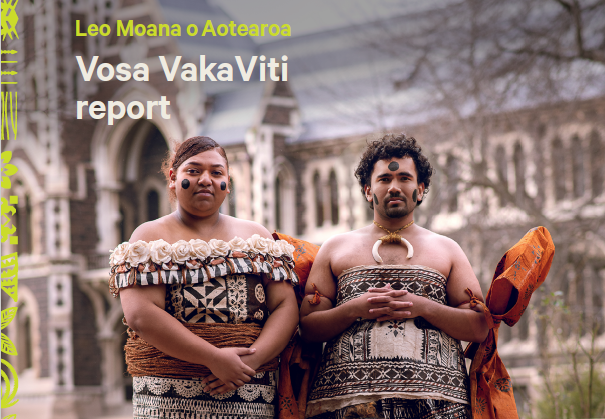
The first report in the Leo Moana o Aotearoa series was published in 2022, and presents pan-Pacific findings from the survey, including baseline data and key themes.
Download the Leo Moana o Aotearoa initial report from 2022 (PDF, 19MB)
Since this report, additional language-specific insights have been captured in a new series of reports into nine Pacific languages.
These reports include deeper insights for each language, including how community characteristics influence attitudes and the maintenance of heritage languages.
We have also published a series of data snapshots alongside the language-specific reports.
These infographics draw together 20 years of Pacific language data from the national Census (2001–2023) and the Ministry of Education (2004–2025).
Together with the language-specific reports, these resources offer a fuller picture of Pacific languages in Aotearoa by showing both their trajectory over time and their current state.
The Leo Moana o Aotearoa Pacific Languages of Aotearoa Project is the first national project of its kind to investigate the use of, and attitudes towards, nine Pacific languages in Aotearoa. It looks at Te Gagana Tokelau, Vagahau Niue, Te Reo Māori Kuki ‘Āirani, Gagana Samoa, Lea faka-Tonga, Te Gana Tuvalu, Vosa Vakaviti, Fäeag Rotuạm Ta and Te taetae ni Kiribati.
The project was launched in 2022, alongside the Pacific Languages Strategy 2022 – 2032.
The objectives of this project are to:
The initial research involved a national survey and talanoa with Pacific communities from nine Pacific groups across New Zealand (Tokelau, Niue, Cook Islands, Samoa, Tonga, Tuvalu, Fiji, Rotuma, and Kiribati).
The Leo Moana o Aotearoa Survey provides detailed information about Pacific language use, proficiency and attitudes that isn’t available from the Census alone.
These contemporary insights strengthen stewardship and help inform policy, strategy and investment to support Pacific language maintenance and revitalisation, including the Pacific Languages Strategy.
The initial Leo Moana survey gathered information from Pacific people aged 15 years age and above about their use of and attitudes towards Pacific languages in New Zealand.
The survey was made available in English as well as nine Pacific languages – te gagana Tokelau, te reo Māori Kuki ‘Airani, vagahau Niue, gagana Samoa, lea faka-Tonga, vosa Vakaviti, te gana Tuvalu, fäeag Rotuḁm, and te taetae ni Kiribati. Many participants completed the survey in their Pacific language.
The Leo Moana Survey was delivered online and was live from November 2021 through to February 2022. It comprised 70 questions covering 10 topics:
A total of 3039 Pacific people completed the survey. Participants were identified across Pacific ethnicity, age, gender, region and birthplace. The sampling frame was designed using data from the 2018 New Zealand census data and is representative of Pacific peoples residing in New Zealand.
Survey results are used to:
The New Zealand Census aims to cover the whole population and provides national demographic and language data.
Leo Moana o Aotearoa is a survey of a sample of Pacific peoples that provides more detailed, policy-relevant insights into Pacific language use, proficiency and attitudes, complementing Census data.
Trends may look similar, but statistics can differ because the populations, questions and methods are different.
While there has been three years since the Leo Moana o Aotearoa survey was conducted and the publication of these reports, trends in language use and attitudes do not change significantly over a short period of time. The insights gathered through the reports will still be relevant to the current state of Pacific languages in New Zealand.
Get in touch with the Ministry for Pacific Peoples at [email protected]